 +1 817 857 6221

In this article (10 sections)
- What Is a Research Paper in a US College Course?
- How to Start a Research Paper: Choosing a Topic
- How to Find Peer-Reviewed Sources (Google Scholar, JSTOR, Library Databases)
- Research Paper Outline Template
- Research Paper Format: Structure and Length
- How to Write, Revise, and Proofread Your Draft
- Common Research Paper Mistakes That Lower Your GPA
- When to Ask for Academic Support
- Frequently Asked Questions About Writing a Research Paper
- Final Thoughts: How to Write a Research Paper With Confidence
Knowing how to write a research paper is one of the most useful skills you will build in a US college. Whether your professor assigns a five-page paper in a first-year composition course or a 15-page paper in an upper-level psychology class, the process is the same: pick a focused question, find credible evidence, organize your argument, and cite every source.
Many students lose points not because their ideas are weak, but because they skip planning or start writing before they have a clear thesis. This step-by-step guide shows you how to start a research paper, build an outline, follow the right research paper format, and revise with confidence. If you want extra support along the way, you can also explore online assignment help for US college students built around your course requirements.
What Is a Research Paper in a US College Course?
A research paper is a piece of academic writing in which you ask a question, gather evidence from credible sources, and build an argument supported by that evidence. Unlike a personal essay, it relies on outside research. Unlike a book report, it does more than summarize: it analyzes, compares, or evaluates what others have found and adds your own conclusion.
In US colleges, research papers usually fall into two types:
- Argumentative research paper: you take a position and defend it with evidence.
- Analytical research paper: you break a topic into parts, examine a question, and present a reasoned interpretation without necessarily arguing for one side.
Before you do anything else, read your syllabus and grading rubric. These documents tell you the required length, the number of sources, the citation style (such as APA, MLA, or Chicago), and how your professor will grade the paper.
How to Start a Research Paper: Choosing a Topic
The best way to start a research paper is to narrow a broad subject into a question you can answer in the space you have. A topic like "social media" is too broad for a 10-page paper. A question like "How does social media use affect sleep quality in college students?" is focused and researchable.
Use these steps:
- Read the assignment prompt and underline the action words, such as analyze, compare, or evaluate.
- Brainstorm three to five topics that fit your course and interest you.
- Do quick background reading in a library database to confirm enough scholarly research exists.
- Narrow your best topic into a single research question.
- Write a working thesis statement you can revise as you learn more.
Here are a few research paper topics for college students to spark ideas:
- The effect of online learning on student engagement at US community colleges
- How sleep habits relate to GPA among first-year students
- Access to telehealth services in rural US communities
- The role of artificial intelligence in business decision-making
Check your topic with your professor or your college writing center before you invest hours in research.
How to Find Peer-Reviewed Sources (Google Scholar, JSTOR, Library Databases)
Strong research papers rely on peer-reviewed sources, which are articles that other experts review before publication. Most US professors expect you to use them instead of general websites.
Where to search:
- Your college library databases: usually free with your student login.
- Google Scholar: good for broad searches and for seeing how often a study has been cited.
- JSTOR and similar databases: access depends on your library.
- Government and education sites: pages ending in .gov or .edu, such as the National Center for Education Statistics (NCES) for education data.
Many US college libraries teach the CRAAP test to judge a source: currency, relevance, authority, accuracy, and purpose. Ask who wrote it, when it was published, who reviewed it, and whether the evidence supports the claims.
Keep a simple source log from day one. For every source, record the author, year, title, key finding, and page number. This makes your annotated bibliography and reference list much faster to build. When you are ready to format citations, use our citation style guides for APA, MLA, and Chicago.
Research Paper Outline Template
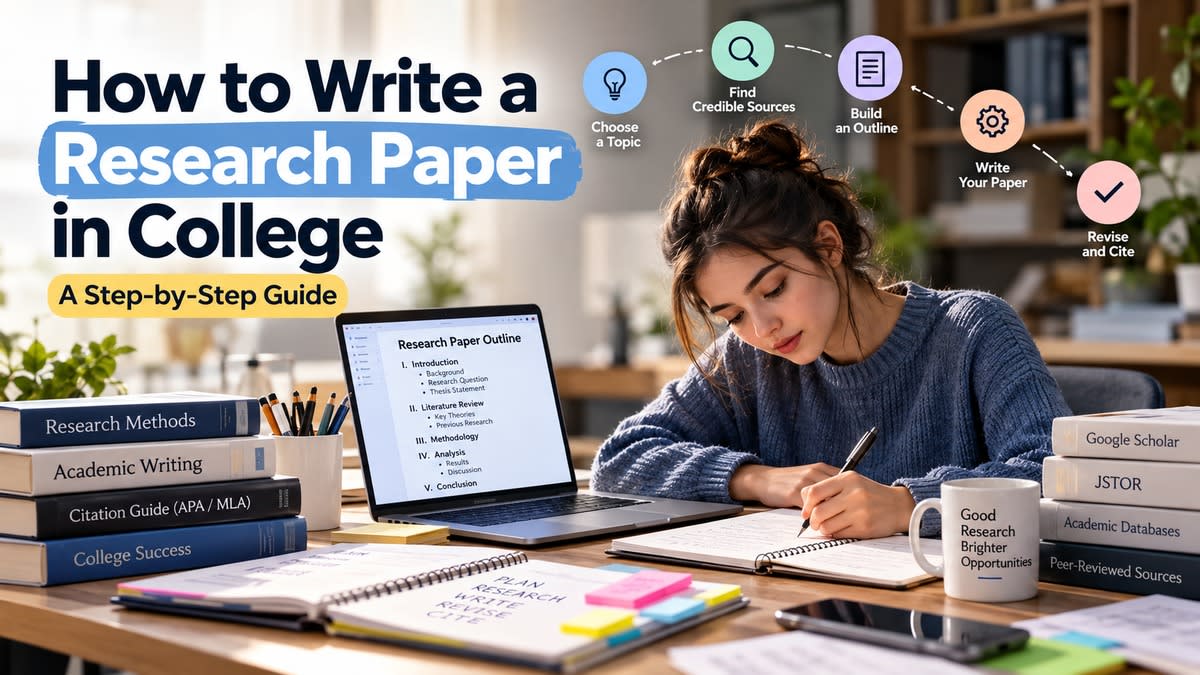
A research paper outline is your roadmap. It shows the order of your ideas and helps you spot weak points before you write a full draft. Use this simple template and adjust it to your assignment:
- Introduction
- Hook that introduces the topic
- Short background on the issue
- Thesis statement
- Body Section 1: First main point
- Topic sentence
- Evidence from sources
- Your analysis
- Body Section 2: Second main point
- Topic sentence
- Evidence from sources
- Your analysis
- Body Section 3: Third main point
- Topic sentence
- Evidence from sources
- Your analysis
- Counterargument and response (for argumentative papers)
- Conclusion
- Restate the thesis in new words
- Summarize key findings
- Explain why the findings matter
- Reference list
Assign each source to the section where you will use it. If a section has no evidence, you have found a research gap to fill. If a source fits nowhere, you may not need it. A good outline also makes your first draft faster, because you already know what each paragraph must prove.
Research Paper Format: Structure and Length
The standard research paper format has these parts, though your professor may require only some of them:
- Title page: your title, name, course, professor, and date. Required in many APA papers.
- Abstract: a short summary of your question, method, and findings. Common in science and social science courses.
- Introduction: the topic, background, and thesis.
- Body: organized sections or headings that support your thesis.
- Conclusion: the answer to your research question and why it matters.
- References or Works Cited: every source you cited in the paper.
How long should a research paper be? Length depends on the course. Many undergraduate papers run from about 5 to 15 pages, but your syllabus has the final say.
Most US college papers use a readable 12-point font such as Times New Roman, double spacing, one-inch margins, and page numbers. Always confirm the exact rules in your assignment.
Citation style usually depends on your field:
- APA: psychology, education, nursing, and other social sciences.
- MLA: English, literature, and many humanities courses.
- Chicago: history and some humanities and business courses.
Use in-text citations every time you quote, paraphrase, or rely on someone else's idea, and match each one to an entry in your reference list.
How to Write, Revise, and Proofread Your Draft
Write your first draft by following your outline, and do not aim for perfection. Your goal is to get your ideas and evidence on the page. Build each body paragraph with the same pattern: a clear claim, evidence from a source, and your own analysis explaining why the evidence matters.
Once the draft is done, revise in two passes:
- Big-picture revision: Does the thesis answer your research question? Does each paragraph support it? Are any sections out of order or missing evidence?
- Sentence-level revision: Tighten wordy sentences, fix grammar, and check that every quote and paraphrase has a citation.
Step away for 24 hours if your deadline allows, then read the paper aloud to catch awkward phrasing. Your college writing center can also give feedback on structure and clarity. Before you submit, run a similarity check if your college provides one, and compare your citations against your reference list one entry at a time.
Common Research Paper Mistakes That Lower Your GPA
These errors cost students points on almost every research paper:
- Starting without a clear thesis: a vague claim leads to a scattered paper.
- Choosing a topic that is too broad: you end up skimming the surface instead of analyzing.
- Using weak sources: blogs and anonymous websites rarely meet professor expectations.
- Summarizing instead of analyzing: a research paper needs your interpretation, not only a list of facts.
- Citing incorrectly: missing or inconsistent citations can raise academic integrity concerns.
- Ignoring the grading rubric: you may write a good paper that misses what the professor is grading.
- Waiting until the last night: research, drafting, and revision each take time.
A simple fix for most of these is to plan backward from your due date. Set a deadline for your topic, sources, outline, first draft, and final revision.
When to Ask for Academic Support
Even strong students hit roadblocks, such as a tight deadline, an unfamiliar topic, or a complex rubric. Start with your professor's office hours and your college writing center. If you want additional guidance, EveryAssignmentHelp offers research paper help from subject specialists who can explain structure, sources, and formatting for US college courses.
Use any model answers or guidance as a learning resource, and always follow your college's academic integrity policy and your professor's rules.
Frequently Asked Questions About Writing a Research Paper
How do I start a research paper if I feel stuck?
Begin with background reading on your topic, then write one research question and a rough thesis. Once you have those, build a simple outline. Starting small is easier than facing a blank page.
How many sources do I need for a research paper?
Your syllabus sets the number. Short papers often require a handful of scholarly sources, and longer papers require more.
Which citation style should I use?
Use the style your professor requires. APA is common in the social sciences, MLA in the humanities, and Chicago in history.
What is the difference between a research paper and an essay?
A research paper depends on outside scholarly sources and formal citations. An essay can rely more on your own ideas and analysis.
Final Thoughts: How to Write a Research Paper With Confidence
Learning how to write a research paper gets easier when you treat it as a series of small steps: choose a focused topic, find peer-reviewed sources, build an outline, follow the correct research paper format, and revise carefully. Start early, read your rubric, and ask for feedback from your professor or writing center. With a clear plan, you can turn a stressful assignment into a paper you are proud to submit.
Get a quote